Jump to HeaderJump to Main ContentJump to Footer
Michigan State University
  • About Us
    • GHI Staff
  • |
  • Research
    • Research Highlights
    • Scholarly Activities
    • Student Research Opportunities
  • |
  • Education
    • Global Health Studies
    • Student Organizations
  • |
  • Outreach
    • Learning and Assessment Center (LAC)
    • Office of Medical Education Research and Development (OMERAD)
    • Mexico
    • Peru
  • |
  • Faculty
    • Faculty Directory
  • |
  • News and Events
    • Events
    • News
  • |
  • Giving
Global Health Institute
  • About Us
  • Research
  • Education
  • Outreach
  • Faculty
  • News and Events
  • Giving

< About Us

  • GHI Staff

< Research

  • Research Highlights
  • Scholarly Activities
  • Student Research Opportunities

< Education

  • Global Health Studies
  • Student Organizations

< Outreach

  • Learning and Assessment Center (LAC)
  • Office of Medical Education Research and Development (OMERAD)
  • Mexico
  • Peru

< Faculty

  • Faculty Directory

< News and Events

  • Events
  • News

< Giving

Global Health Institute > News and Events > Events >

Working With, Through, and From Ubuntu: Toward an African Science of Healing People, Communities, and Places

Resources

  • Find People
  • Maps
  • Email
  • Student Information System (SIS)
  • D2L
  • Libraries
Michigan State University
Global Health Institute

Global Health Institute

September

10

Online (Zoom)

Working With, Through, and From Ubuntu: Toward an African Science of Healing People, Communities, and Places

Hosted by the MSU African Studies Center, Co-Sponsored by the Global Health Institute

Register
SHARE
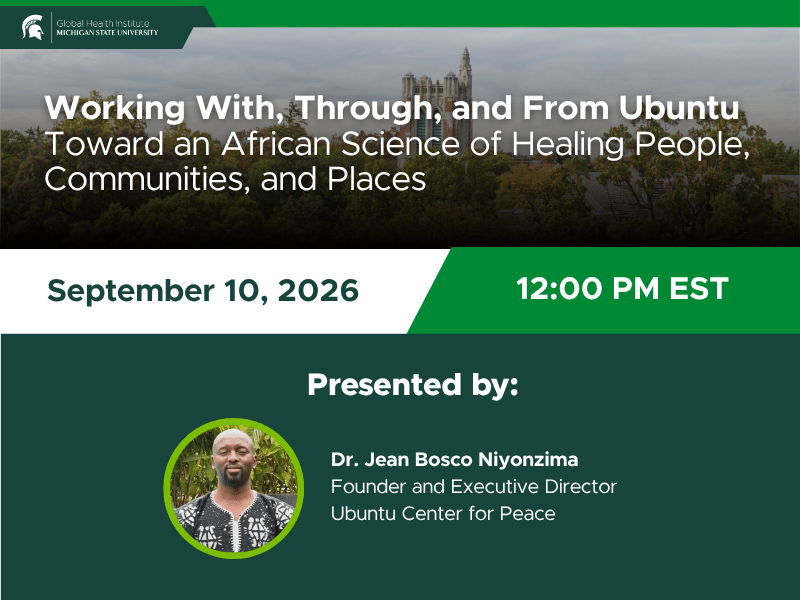
Working With, Through and From Ubuntu, a webinar presented by Dr. Jean Bosco Niyonzima on September 10, 2026 at 12:00 p.m.

About the Talk

What might an African understanding of human interconnectedness contribute to the science and practice of healing?

Drawing on more than a decade of community healing work in post-genocide Rwanda, this lecture explores Ubuntu, not simply as a philosophy, but as a framework for understanding, practicing, and generating knowledge about healing. Through the expansion of Ubuntu Center for Peace (UCP), I reflect on a journey of working collectively and relating with communities affected by internal conflict, while using individual, relational, and community-level evidence to understand what healing makes possible. This experience suggests that healing cannot be fully separated from the relationships and communities in which people live. Trauma can affect individuals, families, relationships, and communities; healing, therefore, may involve restoring connection, dignity, trust, belonging, and collective agency. The lecture explores Ubuntu as simultaneously a worldview, method, and outcome of healing, and considers how this may open a pathway toward a more holistic understanding of wellbeing—connecting the healing of people and communities with the healing of the places and environments in which they live. It asks whether Ubuntu can contribute to an emerging African science of healing-centered development.

About the Speaker

Dr. Jean Bosco Niyonzima is the Founder and Executive Director of Ubuntu Center for Peace (UCP), a Rwanda-based organization advancing community-based approaches to trauma healing, peacebuilding, and collective wellbeing. A physician and public health practitioner by training, he holds graduate degrees in public health, sustainable development, and psychosocial approaches to peacebuilding.

For more than two decades, Dr. Niyonzima has worked at the intersection of trauma healing, community development, and peacebuilding in Rwanda. His work has contributed to the development of UCP’s Community-Based Social Healing model, an Ubuntu-informed approach that integrates embodied healing, relational restoration, and collective processes of healing and social connection.

Dr. Niyonzima is increasingly focused on the development of Ubuntu science: an interdisciplinary effort to explore Ubuntu as a framework for understanding human wellbeing, healing, and collective flourishing, and its potential contribution to mental health, peacebuilding, development, and broader approaches to health.

This webinar is co-sponsored by the MSU Global Health Institute, the Institute of Ubuntu Thought and Practice, and the Alliance for African Partnership.

Register

Tags

Continuing Education

Outreach and Engagement

Date

September 10, 2026

Time

12:00 PM - 1:30 PM

Location

Online (Zoom)

Cost

Free

Organizer

MSU African Studies Center

africa@msu.edu

Health and Safety

  • MSU Police and Public Safety
  • Olin Health Center
  • Counseling & Psychiatric Services (CAPS)
  • University Health and Wellbeing
  • MSU Health Care
  • Health Care Non-Discrimination Notice

Support Services

  • Disability Resources
  • Supportive Services
  • Learning Resources
  • Tech Support

Working at MSU

  • Human Resources
  • EBS Login
  • Employee Assistance Program

Contact us

(517) 353-8992

Address

Michigan State University 909 Wilson Road B320 W Fee Hall East Lansing, MI 48824

Report Issue

Follow Us

  • Visit our Facebook page
  • Visit our Instagram page
  • Visit our LinkedIn page

If you're having accessibility issues, please let us know.

  • Contact Information|
  • Site Map|
  • Privacy Statement|
  • Site Accessibility|
  • Call MSU: (517) 355-1855|
  • Visit: msu.edu|
  • Notice of Nondiscrimination|

SPARTANS WILL|© Michigan State University|